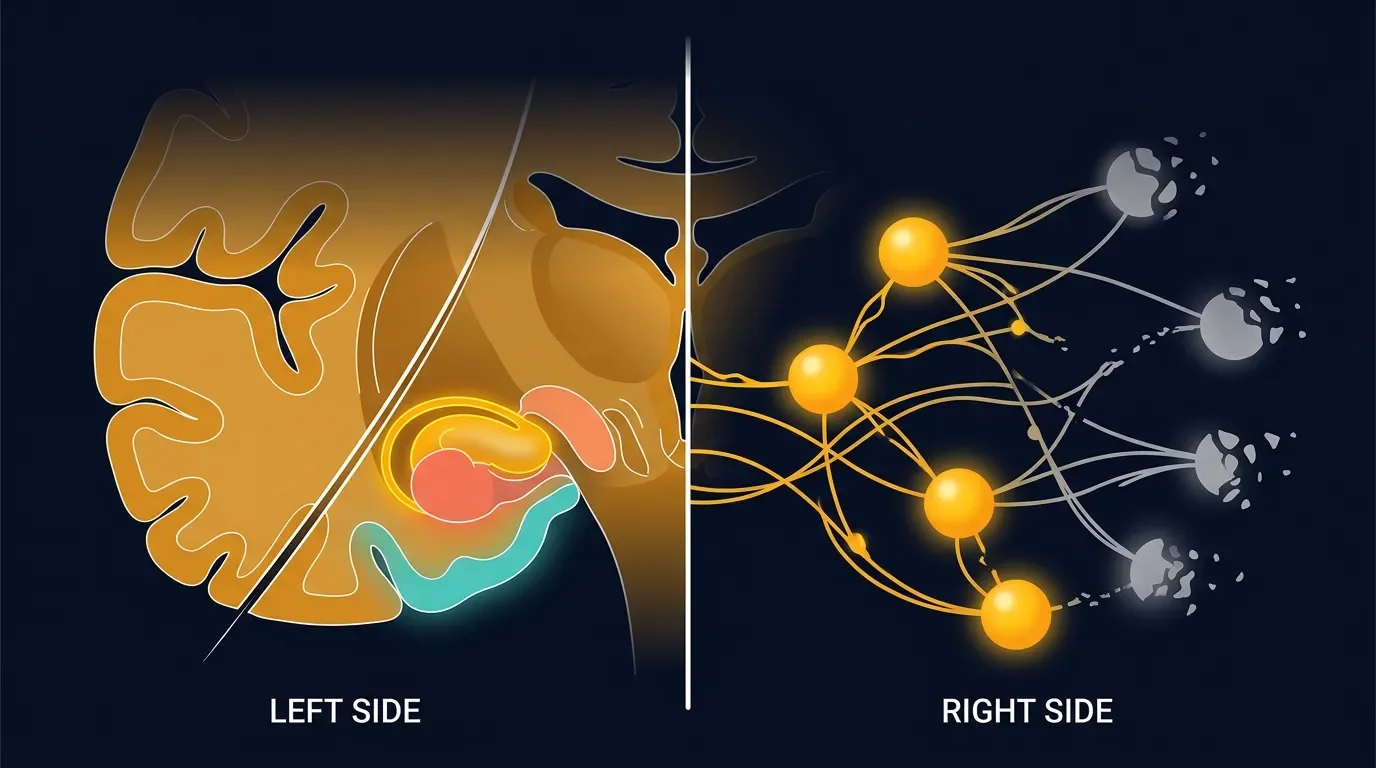
Patient H.M. and the Discovery That Memory Is a Distinct Brain Function
In 1953, a surgical attempt to cure a young man's epilepsy accidentally destroyed his ability to form new memories. This article tells the story of patient H.M. (Henry Molaison), how neuroscientist Brenda Milner extracted fundamental principles from his strange condition, and why the landmark 1957 Scoville & Milner paper established that memory is a distinct brain function handled by the medial temporal lobe — separate from intelligence, perception, or skill learning.
June 16, 2026 · 8:12 AM
1 subscriptions · 19 items
On the morning of September 1, 1953, a 27-year-old man named Henry Molaison lay down in an operating room at Hartford Hospital in Connecticut. Neurosurgeon William Beecher Scoville was about to remove the medial structures of both his temporal lobes — the anterior hippocampi, most of the amygdalae, the entorhinal cortex — in a last-ditch effort to control the severe, drug-resistant epileptic seizures that had made Molaison's life unliveable. The operation worked. The seizures were brought under control.
But when Molaison woke up, he had lost something that no one expected to lose. He could no longer form new memories. He would have a conversation, then forget it entirely a few minutes later. He could be introduced to someone, turn away, and in the time it took to look back, the person had vanished from his mind. He described his experience as "like waking from a dream... every day is alone in itself." 1
This accident — because it was, essentially, an accident — launched the modern scientific study of human memory.
A man who could not make new memories
Brenda Milner, a young researcher at McGill University completing her doctoral work under Donald Hebb, first traveled to Hartford in 1955 to study Molaison after a call between Scoville and neurosurgeon Wilder Penfield. What she found was astonishing not just for its severity, but for its selectivity. 2
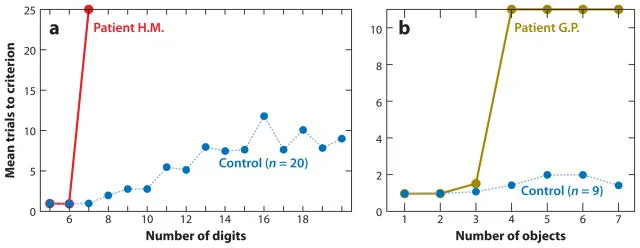
Henry Molaison — known to the world for decades only as "H.M." to protect his identity — was in most respects a normal person. His IQ was intact. His personality had not changed. He could hold a conversation, understand language, recognize faces and objects perfectly. He could repeat back a string of seven digits with no difficulty. He knew who he was, where he had grown up, what had happened to him before the surgery.
The problem was strictly forward in time. From the moment of the surgery onward, new experiences stopped accumulating as memories. Not just some experiences: all of them. Faces, facts, events, places — everything that happened after September 1953 was, within minutes, gone. Milner reported this in a 1957 paper in the Journal of Neurology, Neurosurgery, and Psychiatry, co-authored with Scoville. That paper has been cited more than eleven thousand times. 2
The finding shattered a central assumption in neuroscience. Before H.M., the dominant view — strongly shaped by Karl Lashley's decades of experiments on rats — held that memory is widely and evenly distributed across the cortex, inseparable from general intelligence. H.M. proved the opposite. Memory could be completely destroyed while perception, language, working memory, and intellect remained intact. Memory is a distinct brain function, handled by dedicated circuitry — not a diffuse property of cortex in general. 3
The anatomy of the lesion
What exactly was removed during H.M.'s surgery? Scoville's original description was imprecise by modern standards. He reported removing approximately 8 centimeters of medial temporal tissue bilaterally. Decades later, in 1997, an MRI of H.M.'s brain (by then in his seventies) gave a more precise picture: the lesion was bilaterally symmetrical, extending about 5.4 cm on the left and 5.1 cm on the right from the temporal pole. It included the medial temporal polar cortex, most of the amygdaloid complex, virtually all of the entorhinal cortex, and roughly the rostral half of the hippocampal region (dentate gyrus, hippocampus proper, and subiculum). The perirhinal cortex was substantially damaged; the posterior parahippocampal cortex was largely spared. 3
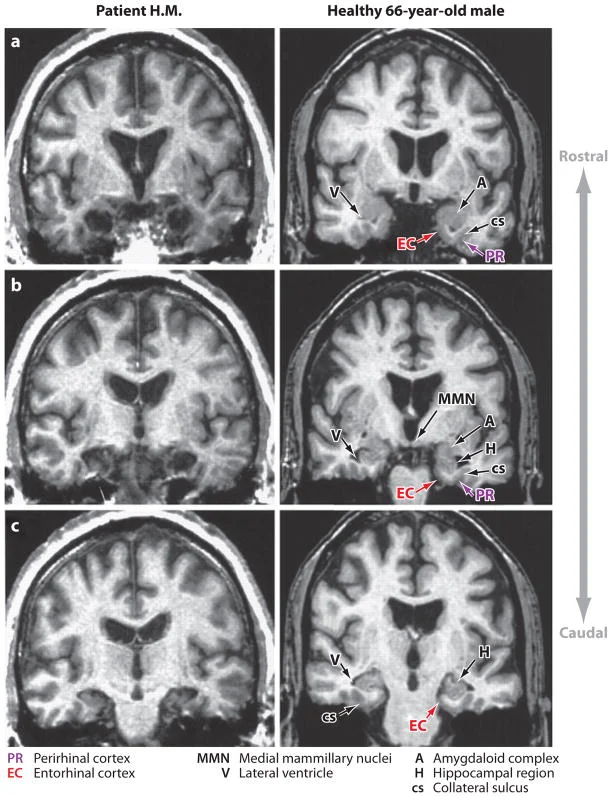
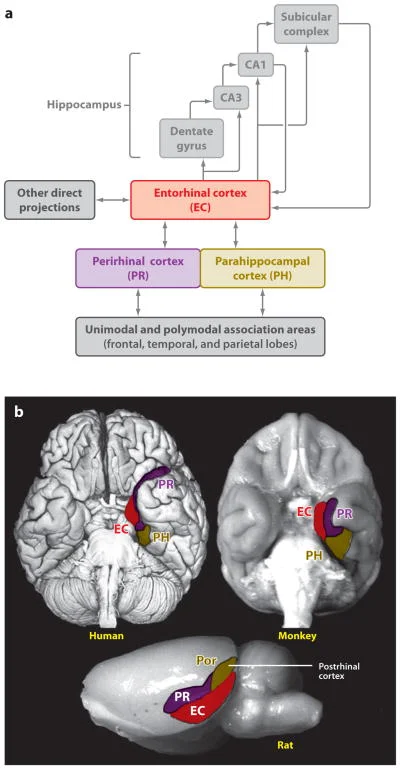
For many years after the surgery, researchers spoke loosely of "the hippocampus" as the critical structure. This turned out to be an oversimplification. H.M.'s memory impairment was far more severe than that seen in patients with lesions limited to the hippocampus alone. A patient studied later, known as R.B., sustained a circumscribed ischemic lesion restricted to the CA1 field of the hippocampus — and showed a measurable but considerably less severe deficit. The lesson: the hippocampus matters, but the adjacent cortical regions along the parahippocampal gyrus — perirhinal, entorhinal, and parahippocampal cortices — matter too. Damage the full system, as in H.M., and the impairment becomes profound.
The anatomy now has a name: the medial temporal lobe (MTL) memory system, formalized in the work of Squire and Zola-Morgan in 1991. It comprises the hippocampus and the surrounding cortical regions that funnel information into it.
What H.M. could still do
The most surprising thing about H.M.'s case was what he could still learn.
In the early 1960s, Milner gave H.M. a mirror-tracing task: trace the outline of a five-pointed star while looking only at its reflection in a mirror. The task is hard at first — the visual feedback is reversed, and every correction your hand makes goes the wrong direction. Over ten trials on the first day, H.M. improved markedly. On the second day, he improved further, and by the third day he made almost no errors. He had learned a motor skill with completely normal acquisition and retention. Yet each time he sat down to do the task, he had no memory of ever having done it before. 1
This dissociation — intact skill learning, destroyed explicit memory — became the foundation for a new taxonomy of memory. Neal Cohen and Larry Squire formalized it in a 1980 Science paper: declarative memory (consciously accessible knowledge of facts and events) versus procedural memory (skill-based, implicit, developed through repetition without conscious access to what is being learned). H.M.'s medial temporal lobes were essential for the former; the latter, they proposed, was supported by other structures — the basal ganglia, the cerebellum. 3
Over subsequent decades, the umbrella of non-declarative memory expanded further. It now includes motor skill learning, habit formation, simple associative conditioning, repetition priming, and perceptual learning — all of which survive extensive MTL damage. Each has been linked to distinct neural substrates. What H.M. could not do was form declarative memories: facts (semantic memory) and personally experienced events (episodic memory).
The question of remote memory
One of the most important early observations about H.M. was not what he had lost going forward, but what he had retained looking backward.
His early memories — childhood, adolescence, his first jobs — were intact. He could recall events from his life before the surgery. When shown photographs of famous people from the 1920s, 1930s, and 1940s, he recognized them normally. He had what is called retrograde amnesia only for a limited period leading up to the surgery (roughly 1 to 3 years before 1953, and more inconsistently for up to 11 years before), not for his entire pre-surgical life.
This was a crucial clue. If the hippocampus were the storage vault for memory, destroying it should have wiped out all memories, including old ones. Instead, old memories survived. The hippocampus must not be where memories ultimately live. It must instead be a relay station — critical for encoding new memories and for a period of consolidation afterward, but eventually the memory is transferred to neocortex and no longer depends on the hippocampus. This process became known as systems consolidation: the gradual reorganization of memory from hippocampal-dependent to cortically distributed storage, across weeks or years.
There is ongoing debate about how complete this transfer is, particularly for episodic memories with rich autobiographical detail. Some researchers (the "standard consolidation" camp) argue that semantic facts eventually become hippocampal-independent, while others (the "multiple trace theory" camp, associated with Morris Moscovitch and Lynn Nadel) argue that richly detailed autobiographical memories always require the hippocampus, no matter how old. H.M. himself was not an ideal test case for this debate — by the time the most rigorous tests were administered, he was elderly and showed signs of additional cortical deterioration. 1
How it connects to place cells
Readers of this channel will immediately notice the parallel. H.M.'s surgery destroyed the hippocampus — the very structure whose cells John O'Keefe discovered in 1971 fire as a rat traverses specific locations in an environment, building a cognitive map. And the grid cells of the medial entorhinal cortex, found by the Mosers in 2005, feed directly into this hippocampal system. The MTL structures removed from H.M. are precisely the structures at the heart of the spatial navigation circuit covered in previous articles.
This convergence is not a coincidence. The hippocampus does not maintain separate departments for "spatial maps" and "episodic memories." The same cellular machinery that lets a rat build a map of a maze also underlies the human capacity to replay the sequence of events at a specific time and place — what Endel Tulving called episodic memory: memory for events localized in space and time, re-experienced from a first-person perspective. H.M. could not form new episodic memories, and he could not form reliable new cognitive maps of environments he encountered after 1953 (though, remarkably, he did slowly develop a rough map of the house he moved into after surgery, suggesting at least partial spatial learning through some other route).
Why the case still matters
Henry Molaison died on December 2, 2008, at 82. He never knew his own name had become famous; he could not retain that fact. His brain was preserved at UC San Diego, sectioned into 2,401 histological slices in 2009, and a digital atlas was made publicly available in 2014 — the most precisely mapped human lesion in neuroscience.
What the case established cannot be overstated. Before 1957, there was no scientific consensus that a specific brain region was critical for memory. After Scoville and Milner, there was. The medial temporal lobe is not optional for new declarative learning; it is the gateway through which experience becomes lasting memory. Without it, every moment vanishes as soon as attention shifts. 2
The case also established that memory is not a monolithic faculty. There are at least two major divisions — declarative and non-declarative — and within declarative memory, there are further divisions between episodic memory (personally experienced events) and semantic memory (facts about the world). These distinctions, now foundational in cognitive neuroscience, have neurological grounding: lesions can abolish one while sparing another. H.M. was the living proof.
Brenda Milner is now over 100 years old and still scientifically active. Looking back in a 2009 essay, Squire wrote that what assured H.M.'s place in history was that he was the right patient encountered by the right scientist at the right moment. Milner's rigor and conceptual clarity allowed her to extract principles from his peculiar situation that a less systematic observer might have missed. The contribution of H.M. to science — made without his full understanding, over five decades of tests and interviews — is one of the strangest and most consequential partnerships in the history of neuroscience.
Landmark paper: Scoville WB, Milner B. Loss of recent memory after bilateral hippocampal lesions. Journal of Neurology, Neurosurgery, and Psychiatry. 1957;20(1):11–21. DOI: 10.1136/jnnp.20.1.11 | PMID: 13406589 | 2
Course connection: MIT 9.13 The Human Brain (Prof. Nancy Kanwisher) covers the hippocampus and declarative memory directly in the navigation and memory modules; the H.M. case is discussed as the foundational lesion study establishing the MTL memory system. See also the OCW lecture notes: 4
Add more perspectives or context around this Post.